
The Financial Planner Competencies That Firms Want to See On Your Resume
Most new planners hit the same wall.
You've done the coursework. You've passed the exam, or you're close. You start looking at job postings, but you’re struggling to find one that feels like you’re “qualified enough.” You check off the technical boxes, but the listings ask for things you didn't study for: Communication skills, critical thinking, building trust with clients, or leadership.
While you know you’ve got some of these skills, you don’t always know how to translate that into a resume or experience items. But you know these aren’t “nice to haves” for firms. In fact, these skills (or rather, competencies) are the primary thing being evaluated after you’ve met experience or education requirements.
Most new planners have no roadmap for developing these competencies, either. Thankfully, the Financial Planning Association does.
Meet the financial planning competencies
In June 2025, FPA released the FPA Competency Model, a framework defining the behavioral skills that drive success in financial planning. Hannah Moore, CFP®, Founder of Amplified Planning, chaired the task force that developed it. Read more about it here.
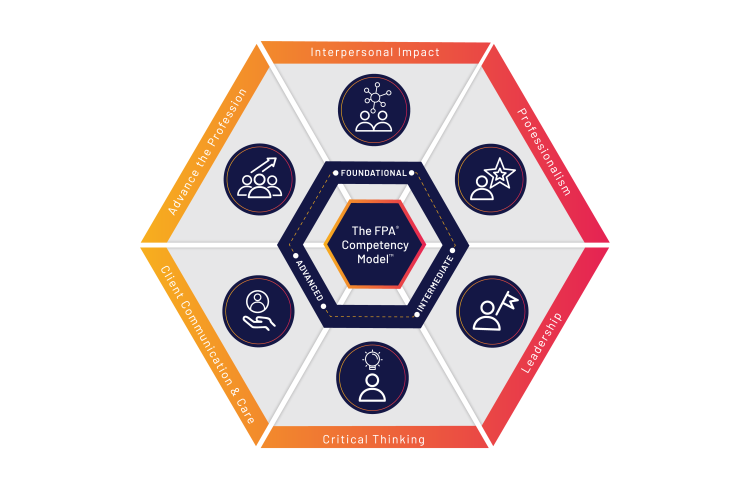
If you're entering this profession or trying to grow within it, it’s important to understand this model because firms will increasingly hire based on its guidelines (and assessments). There are six of these competencies, and they go as follows:
- Interpersonal Impact: Building meaningful, effective relationships that positively influence clients, colleagues, and the profession.
- Professionalism: Maximizing productivity, maintaining ethical practice, and responding resourcefully to new, ambiguous, and challenging situations in service to clients.
- Critical Thinking: Applies intentional and reflective thinking to support sound judgment, decision-making, and problem-solving that serve the client’s best interests.
- Client Communication and Care: Builds collaborative client relationships that integrate both technical and human insight to deliver a personalized financial planning experience.
- Advance the Financial Planning Profession: Expands the reach, capability, and positive impact of financial planning through professional advocacy, inclusive community-building, and service to the public.
- Leadership: Advancing financial planning practice goals through others by fostering team development, personal influence, business growth, and professional innovation.
What These 6 Competencies Look Like on a Resume
Each of the FPA competencies shows up in hiring conversations more than most new planners expect.
1. Interpersonal Impact
This is all about building trust through empathy and genuine connection with clients, colleagues, and collaborators.
In a hiring context, interviewers are evaluating this when they ask how you've navigated a hard conversation, handled a disagreement, or supported someone through something difficult. On a resume, it shows up in roles where you managed relationships, led teams through conflict, or worked in client-facing service where the stakes were high.
Pro tip: When you see “business development” or “sales required” on a resume, this is usually what firms need to see to know that you can convert leads to clients. Reframe: rather than sales, talk to the firm about how you see this as interpersonal impact!
2. Professionalism
Those who display this “professionalism” competency act with integrity, follow through on commitments, and demonstrate a genuine commitment to growth.
In a hiring context, this is what interviewers are really assessing when they ask about a mistake you made and what you learned from it, or how you've responded to critical feedback or stressful situations. On a resume, it can appear as consistency and employment experience: years in a role, evidence of role progression/promotion, and work with teams, customers, or both.
3. Leadership
Potential leaders inspire and influence others, contribute to something beyond your individual role, and lead with clarity of purpose.
This one surprises new planners who aren't thinking of themselves as leaders — or don’t want to be in the most traditional sense of the word. But leadership shows up in how you manage your past peers or customers, how you advocate for a project or someone’s best interest when it's uncomfortable to do so, and how you contribute to a team when you're the most junior person in the room. In interviews, it often surfaces in questions about a time you took initiative or influenced a decision you didn't control. On a resume, it appears in committee roles, volunteer leadership, mentoring, and projects you spearheaded rather than were assigned to.
4. Critical Thinking
Everyone thinks they have this one in the bag, because we all need critical thinking in our day-to-day lives. This competency is actually less common than you’d think, though, because it’s not just about “understanding what to do next” or “common sense.” Critical thinking is all about thinking reflectively and analytically to support sound judgment and well-reasoned decisions.
In a planning setting, it’s not just about running the numbers and checking they're correct. It's about knowing which numbers to run, and why. It's recognizing when a situation is more complex than the planned process and slowing down to think it through. In interviews, it comes up when you're asked to walk through how you approached a difficult problem or made a decision with incomplete information. On a resume, it surfaces in roles where analysis, research, or independent judgment were central to the work.
5. Client Communication and Care
Do you communicate clearly and adapt your approach to the specific person in front of you, while genuinely prioritizing their wellbeing?
This is distinct from interpersonal impact. It's specifically about how you explain complex information, how you adjust when it’s clear someone doesn’t understand, and how you make sure clients leave a conversation with clear steps on what happens next and why. In interviews, it appears in questions about how you've communicated difficult information or tailored your approach to different people. On a resume, it shows up in any role that required explaining complexity, such as training, teaching, customer-facing work, or troubleshooting with an individual or team.
6. Advancing the Financial Planning Profession
This competency is all about pushing the profession forward through advocacy, engagement, and a genuine sense of shared responsibility for its future. Admittedly, this is the hardest to show in past experience, unless you’ve been focused on this career path for a while.
However, your passion for the profession shows up in how you talk about financial planning with people who don't know what it is, whether you engage with professional associations and communities, and whether you think of your work as connected to something larger than your own client list. In an interview, it appears when you're asked why you chose this profession. On a resume, it shows up in resume experience like The Externship or Amplified Planning CORE (sorry, shameless plug 😉), FPA membership, pro bono work, community financial education, and professional development that goes beyond experience or CE hours.
You May Already Have More of These Competencies Than You Think
For new planners and career changers, the FPA Competency Model does something that hasn't existed before in this profession: it gives you a shared language for the skills firms are already evaluating, and a roadmap for building them intentionally rather than hoping you develop them in your first (or next) job.
Career changers, in particular, often arrive with competency depth that students and newer planners haven't had time to build: leadership developed in other industries, critical thinking honed under pressure, and interpersonal skills built through years of client or team work. The model gives them a framework to see what they already have and identify what to develop next, rather than feeling like they're starting over.
For current professionals who are mid-career and pursuing their CFP while job searching at the same time: the competencies you've been developing in previous roles matter here. You're not behind. You're building on something.
And for students, understanding the competencies gives you a leg up against your peers who are applying to the same internships and roles you are. It can also help you stand out in your program, which builds connections and work experience.
For anyone at any stage, the practical implication is the same: don't wait for experience to help you hone these competencies. Start by taking the FPA's free self-assessment at fpalearning.onefpa.org/FPACompetencyModel. Their assessment shows you where you are across all six domains and where to focus next, so you can build your resume in the right direction.
Interested in more tips like these? Make sure to join the Amplified Planning Newsletter!
And if you're looking for a place to build the competencies this model describes through actual client work, coaching, and practice: that's what Amplified Planning CORE was built for. Members get access to an entire library of real client meetings that help them build their interpersonal impact, professionalism, client care, and more. Every call develops the
professional you're becoming, and boosts your resume at the same time.